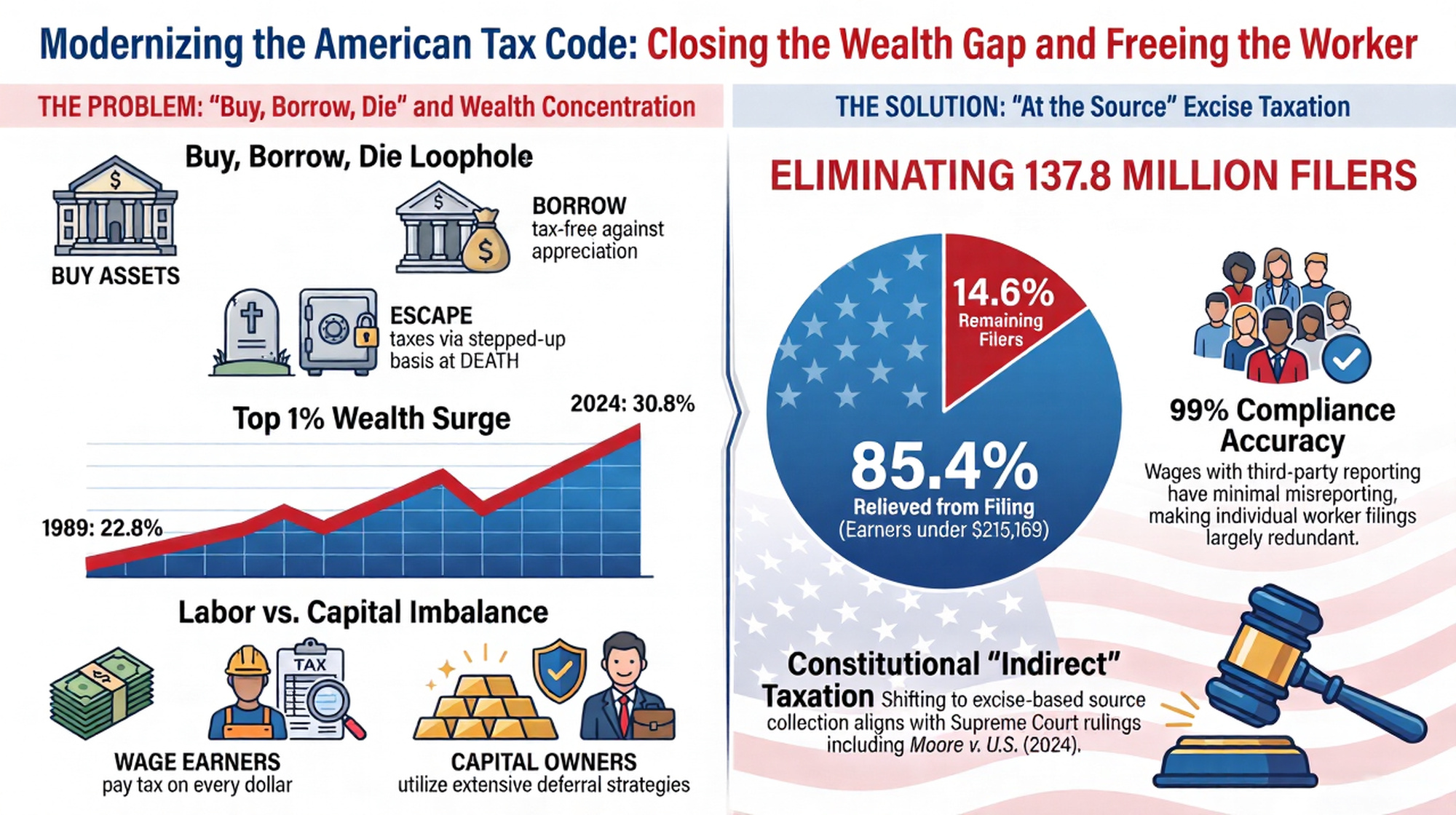
USA Wage Tax Proposal
IRS Definition of Direct Taxes (Educational Series)
"A tax that cannot be shifted to others, such as the federal income tax."
IRS Definition of Indirect Taxes (Educational Series)
"A tax that can be shifted to others, such as business property taxes."
" An indirect tax is one that can be passed on -or shifted- to another person or group by the person or business that owes it."
American Express Co. v. Michigan, 177 U.S. 404 (1900)
"As the means by which the burdens of taxes may be shifted are as multiform and as various as is the power to contract itself, it follows that the argument relied on, if adopted, would control almost every conceivable form of contract, and render them void if they had the result stated. Thus, the price of all property, the result of all production, the sum of all wages, would be controlled irrevocably by a law levying taxes if such a law forbade a shifting of the burden of the tax and avoided all acts which brought about that result. It cannot be doubted that to adopt by implication the view pressed upon us would be to virtually destroy all freedom of contract, and in its final analyses would deny the existence of all rights of property."
Moore v. United States (2024)
"Article I of the Constitution affords Congress broad “Power To lay and collect Taxes, Duties, Imposts and Excises.” Art. I, §8, cl. 1. That power includes “‘two great classes of’” taxes—direct taxes and indirect taxes. Brushaber v. Union Pacific R. Co., 240 U. S. 1, 13 (1916). Generally speaking, direct taxes are those taxes imposed on persons or property." ...
By contrast, indirect taxes are the familiar federal taxes imposed on activities or transactions. That category of taxes includes duties, imposts, and excise taxes, as well as income taxes. U. S. Const., Art. I, §8, cl. 1; Amdt. 16.
Calculated with data from:
'Dataset: 'Table 3.1. Government Current Receipts and Expenditures [Billions of dollars].' U.S. Bureau of Economic Analysis. Last revised March 27, 2025. b) Dataset: 'Table 3.2. Federal Government Current Receipts and Expenditures [Billions of dollars].' U.S. Bureau of Economic Analysis. Last revised March 27, 2025. c) Dataset: 'Table 3.3. State and Local Government Current Receipts and Expenditures [Billions of dollars].' U.S. Bureau of Economic Analysis. Last revised March 27, 2025. d) Dataset: 'Table 5.11U. Capital Transfers Paid and Received, by Sector and by Type [Millions of Dollars; Quarters Seasonally Adjusted at Annual Rates].' U.S. Bureau of Economic Analysis. Last revised March 27, 2025."
Stanton v. Baltic Mining Co., 240 U. S. 103
"... it was settled that the provisions of the Sixteenth Amendment conferred no new power of taxation but simply prohibited the previous complete and plenary power of income taxation possessed by Congress from the beginning from being taken out of the category of indirect taxation to which it inherently belonged and being placed in the category of direct taxation subject to apportionment by a consideration of the sources from which the income was derived, that is by testing the tax not by what it was-a tax on income, but by a mistaken theory deduced from the origin or source of the income taxed."
Stanton v. Baltic Mining Co., 240 U.S. 103 (1916)Eisner v Macomber (1920)
"As repeatedly held, this did not extend the taxing power to new subjects, but merely removed the necessity which otherwise might exist for an apportionment among the States of taxes laid on income. Brushaber v. Union Pacific R. R. Co., 240 U. S. 1, 17-19; Stanton v. Baltic Mining Co., 240 U. S. 103, 112 et seq.; Peck & Co. v. Lowe, 247 U. S. 165, 172-173.
A proper regard for its genesis, as well as its very clear language, requires also that this Amendment shall not be extended by loose construction, so as to repeal or modify, except as applied to income, those provisions of the Constitution that require an apportionment according to population for direct taxes upon property, real and personal. This limitation still has an appropriate and important function, and is not to be overridden by Congress or disregarded by the courts."
"FECA’s political-party coordinated-expenditure limits violate the First Amendment."
"National Republican Senatorial Committee v. Federal Election Committee, Docket number 24-621, dated 6/30/26."
National Republican Senatorial Committee v. Federal Election Committee